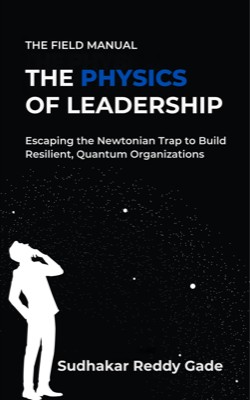
The Physics of Leadership.
Quantum and Vedantic frameworks applied to leadership transformation. Entanglement, dissipative structures, wave-particle duality. Akasha. Dharma. The intellectual capstone of the Organisational Physicist identity.
Three things this book gives a working leader.
How physics reframes what leadership is.
Why classical and quantum physics, taken seriously rather than as metaphor, give the practice of leadership a precision the discipline has not had before. Includes the conceptual scaffolding — the four laws of organisational thermodynamics — that anchors the rest of the book.
Six named phenomena every senior leader is living through.
Fragile Victor Syndrome. Akasha Innovation. Dissipative Leadership. Wave-Particle Stance. Entanglement Trust. The Proximity Paradox. Each phenomenon is named, diagnosed, and given an instrument that lets the leader measure where they sit on the curve.
Why Vedanta is the operating system, not the wallpaper.
The Indian intellectual lineage — dharma, akasha, the discipline of inward attention — is not decorative scaffolding around western leadership theory. It is the deeper layer that makes the physics models cohere. The book argues for the integration without softening either side.
Why physics. Why now.
Leadership theory has spent forty years describing leaders. It has not done much to explain them. Practitioners have inherited a vocabulary of traits, styles, competencies — adjectives stacked on adjectives, with no underlying mechanism that says why one set of behaviours produces a thriving organisation and another does not. Physics works differently. Physics names a force, then tests for its presence. The book argues that leadership becomes a precise discipline only when its practitioners agree to do the same thing.
Six forces are named. Each is drawn from a real domain of physics — quantum entanglement, dissipative thermodynamics, wave-particle duality, the quantum vacuum — and each is mapped to a measurable phenomenon inside an organisation. Fragile Victor Syndrome describes the leader whose external metrics are improving while their internal stakeholder relationships are collapsing. Entanglement Trust describes why two leaders who have never been in the same room can move together with more coherence than two leaders who share a wall. The forces are not metaphors. They are explanatory frameworks with diagnostic instruments attached.
And Vedanta. Beneath the physics layer the book runs a continuous argument that the Indian intellectual lineage has been doing this kind of work for two thousand years — naming a force, locating its practice, holding the practitioner accountable to the measurement. Akasha. Dharma. Not as ornament. As the operating system on which the physics models compile. The integration is the contribution. The book is not the first to say physics matters to leadership. It is the first to insist that physics matters precisely because Vedanta already said so.
Six leaders. Six different kinds of recognition.
For the first time, I have a vocabulary for what I have been feeling on the inside while my numbers were going up. The Fragile Victor chapter found me in the second paragraph.
A book that takes physics and Vedanta seriously, in the same sentence, without softening either. I have not seen that done before. I will be teaching from it.
The Entanglement Trust chapter explained eighteen months of distributed-leadership pain in our organisation. Re-read it three times the same week. Sent it to my eight directs.
A coach who can write at this level is rare. A coach who can write at this level and ground it in working measurement instruments is something I have not encountered.
Reads like a working paper that decided it would also be a book. The argument compounds. By the last chapter you cannot un-see what is going on inside your own organisation.
Sudhakar's first two books named the inward work. This one names the system. The arc finally makes sense — and the third book justifies the first two.
Endorsements anonymised by sector and seniority at request of readers. Named blurbs published with permission as they land.
The book is available on Amazon India.
Order on AmazonU R Unique
Self-mastery. Reprogramming the limiting beliefs that keep capable leaders from doing what they already know how to do.
The AI-Ready Leader
A field guide for senior leaders deciding what AI changes — and what it does not. Twelve frameworks tested with leaders shipping AI inside Fortune 500 organisations.