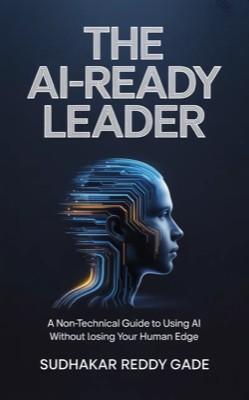
The AI-Ready Leader.
A field guide for senior leaders deciding what AI changes — and what it does not. Twelve frameworks tested with leaders shipping AI inside Fortune 500 organisations.
Three things this book gives a leader navigating the AI transition.
The AI Capability Radar — what is automatable, augmentable, human-bound.
The first deliverable in any AI engagement. A working diagnostic that maps an organisation's AI surface area against its leadership readiness. The book walks the reader through one full radar cycle for their own portfolio.
Six AI frameworks every executive can deploy this quarter.
AI Capability Radar. Decision Velocity Matrix. Quantum Prompt Architecture. AI Adoption Arc. AI Ethics Compass. Personal AI Stack Builder. Each framework comes with a worked example from a real engagement, with names and identifying details changed.
The AI Adoption Arc — five stages, with behavioural signals for each.
Denial. Pilot. Integration. Dependency. Redesign. Every organisation moves through these stages, and most do it without the leader noticing the transition. The book gives the reader the signals to spot each shift before it arrives.
What AI changes — and what it does not.
The conversation about AI in most boardrooms is still binary — either AI changes everything, or AI changes nothing, with positions taken according to the leader's appetite for risk. The book argues that both positions miss the actual question. AI changes a specific subset of the leader's day — the parts of the day that were already automatable in principle but not in practice. Everything else stays human-bound. The work is to know which is which, and to redesign the calendar accordingly.
The frameworks make the redesign concrete. The AI Capability Radar divides the leader's accountability surface into three zones — automatable, augmentable, human-bound — and lets the leader stop arguing and start measuring. The Decision Velocity Matrix explains why some decisions move faster with AI in the loop and others slow down despite the model being right. The AI Adoption Arc names the five stages every organisation moves through and tells the leader how to see the next stage before the organisation surfaces it.
And the leader's own muscle. The most consequential chapter argues that the executives most at risk in the AI transition are the ones who delegate too much of their thinking to the model too soon. Leverage without dependence is the discipline. The book closes with the Personal AI Stack Builder — a model for executives to construct a working AI workflow that compounds their thinking instead of replacing it. The discipline is the deliverable.
Six leaders. Six different kinds of recognition.
A book that finally treats AI as a leadership instrument rather than a technology to be implemented. The Capability Radar replaced four spreadsheets in our portfolio review the week I read it.
Sudhakar wrote the book I needed two years ago. The Decision Velocity Matrix alone is worth the cover price — it explained why my best AI pilots were the ones that slowed our process down.
Reads like the field manual that the AI consulting industry should have written and didn't. Practical to the point of inconvenience for the rest of the genre.
The Personal AI Stack Builder is a quiet masterpiece. I have been using AI heavily for eighteen months. The book taught me that I had been doing it wrong in a specific, identifiable way.
The Ethics Compass is not a manifesto. It is a decision instrument. That distinction is the difference between the book working in practice and not.
A coaching book about AI written by a coach who actually understands the technology. The combination is rarer than it should be.
Endorsements anonymised by sector and seniority at request of early readers. Named blurbs published with permission as they land.
The book is available on Amazon India.
Order on AmazonThe Physics of Leadership
Released January 2026. The intellectual capstone — quantum and Vedantic frameworks applied to leadership transformation.
The Coaching Room
Forthcoming. The working coach's notebook — selected sessions, anonymised case studies, the discipline of sitting still while a leader works out what they already know.