
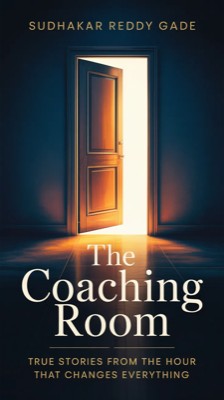
The Coaching Room.
What happens between two chairs. The working coach's notebook — selected sessions, anonymised case studies, the discipline of sitting still while a leader works out what they already know.
Three things this book gives the working coach — and the leader they sit with.
The discipline of sitting still.
The most consequential skill a coach develops is the willingness to not rescue. The chapter opens with three coaching transcripts, lightly redacted, where the coach said almost nothing for thirty minutes and the leader did the entire piece of work. The discipline is the deliverable.
Twelve anonymised sessions, in full.
Not summaries. Full sessions, with permission, names changed and identifying details altered. Each session is followed by a short author's note explaining what was happening for the coach, what was being held back, and what the coach is still learning years after the engagement closed.
Why coaching is exact, not soft.
The closing chapters argue that the soft language around coaching — empathy, presence, holding space — has been carrying the discipline backwards for two decades. Coaching is precision work. The book documents the precision in a way the genre rarely does.
What happens between two chairs.
The coaching room is the most underdocumented space in modern leadership development. The work happens between two chairs, behind a closed door, and almost no working coach writes down what actually goes on. The book is an attempt to do that — to take the room seriously enough to put it on a page. Twelve sessions are reproduced in full, with permission, with names changed and identifying details altered. The reader sits in the room with the coach.
The transcripts are uncomfortable in the way good coaching is uncomfortable. There are long silences printed as long silences. There are sentences from the coach that look ordinary on the page and were doing precise work in the room. There are moments where the coach was wrong and is honest about being wrong. The book argues that the documentation is overdue — that coaching has hidden behind language about presence and empathy for too long, and that the practice deserves the kind of precision the rest of the leadership disciplines have learned to demand.
The fifth book in the arc closes the loop. The first book argued for the awareness. The second taught the inward work. The third gave the system its physics. The fourth extended the system into the AI transition. The fifth shows the room where all of it happens. A working notebook. Not a manifesto. Not a methodology. A coach's room, held open long enough for the next coach to learn the shape of the work.
Six readers. Six different kinds of recognition.
A book the coaching profession has needed for two decades. Reads like a master class held in the cleanest classroom I have ever sat in.
The first session in the book — the one with the silence at the seven-minute mark — taught me something about my own practice that fifteen years of supervision had not surfaced.
I have been coached for nine years. This book is the first time I have understood what was actually happening on the other side of the chair.
Sudhakar's willingness to publish the moments where he was wrong is the thing that makes this book different from anything else in the genre.
If you are training to be a coach, this book is the one I would give you on day one. It earns the seriousness the discipline deserves.
A perfect close to the five-book arc. The first four books explained the work. This one shows it.
Endorsements anonymised by sector and seniority at request of early readers. Named blurbs published with permission as they land.
The book is available on Amazon India.
Order on AmazonThe AI-Ready Leader
A field guide for senior leaders deciding what AI changes — and what it does not. Twelve frameworks tested with leaders shipping AI inside Fortune 500 organisations.
R U Coached!
The case for executive coaching as a defining leadership act. Why the leaders who hire a coach early outperform the ones who wait.