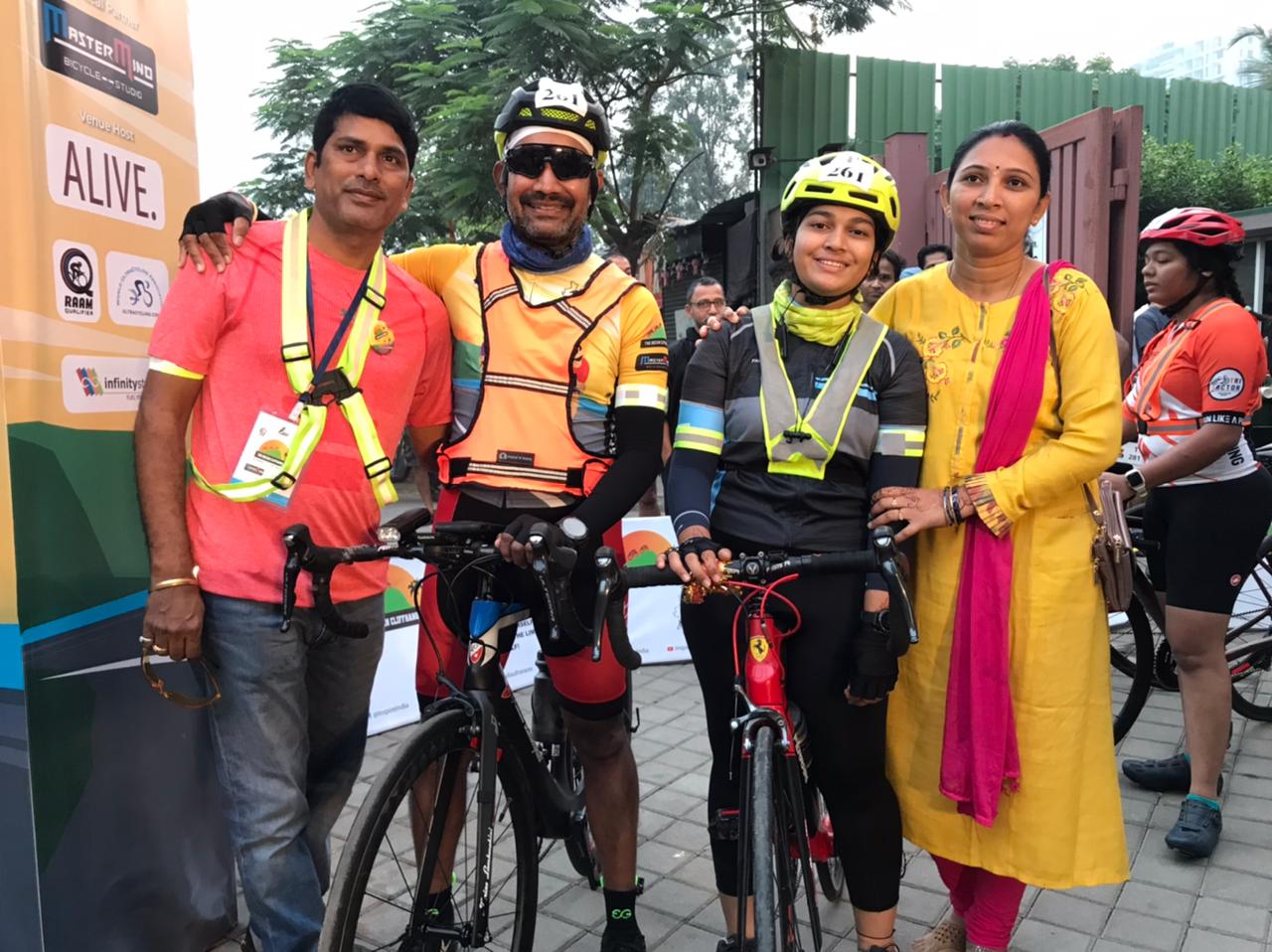
I cannot show you the leaders I coach. The First Discipline forbids it. So I will show you the only person whose arc I am free to document — and I will tell you upfront that she is family. Niharika Reddy Marapareddy is my sister's daughter. She is also the first athlete I ever coached. Both things are true, and I would rather you heard the first one from me than found it in a race report.
In 2020 she was in Class 10 and had never cycled seriously in her life.
Twenty-five kilometres. Then fifty. Then a hundred, in a single day.
On 26 November 2022 we rode from Pune to Goa. Six hundred and forty-three kilometres, over the Sahyadris, down through Amboli ghat, against a thirty-one hour wall. We crossed the line in 30:54:44.
Five minutes and sixteen seconds. That was the whole margin. She was sixteen years old and the youngest rider in the race.
Nine months later we went to Ladakh.
The Great Himalayan is the highest ultracycle race in the world. Six hundred kilometres from Leh to Drass and back to Thiksey, over Fotu La at 13,479 feet — twice. Cold rain on the first climb. A headwind that felt personal. We were flagged off at six in the morning on 26 August 2023 and we finished at Rover's Den at 8:53 the following night.
Thirty-eight hours and fifty-three minutes. The cut-off was thirty-nine.
Seven minutes. We had beaten the mountain by seven minutes.
Then the officials read out the penalties. Our follow vehicle had parked where it should not have. Later, in the dark, it had failed to hold its designated distance behind the rider. And on one steep descent, thirty hours in, Niharika had drifted outside the curtain of the road.
Forty-five minutes. Official time 39:35. Over the limit by thirty-five.
The sheet records our category position, and the letters OTL beside it. We were over the cut-off; that is the result that counts. Both of those are on the Inspire India sheet and you are welcome to check.
Here is what I have thought about every year since.
Two of those three infractions were not committed on a bicycle. They were committed by the vehicle behind us — the system we had built to keep us safe, staffed by people who loved us, operating at the edge of its own exhaustion. We spent thirty-eight hours generating a performance and lost the result to a support structure we had never audited.
I have watched that exact thing happen to a Chief Operating Officer who hit every number and lost the succession to a conversation in a room she was not in. I have watched it happen to a business head who delivered the turnaround and was penalised for how the reporting line behaved while he was busy delivering it.
The rider is almost never the problem. The rider is almost always the one who pays.
And the third penalty — hers — is the one I use most in the coaching room. A seventeen-year-old, thirty hours deep, at altitude, on a descent. Her legs were fine. Her power was fine. What had thinned was the layer that makes small judgments about lane position. That is precisely what month nine of a transformation looks like in a CXO: output intact, decision quality quietly degrading, and no instrument anywhere in the organisation measuring the second thing.
She finished, by the way. At seventeen, Niharika became the youngest participant in that race's history and the first woman ever to finish The Great Himalayan.
A girl who had never cycled stood at 13,479 feet and did something no woman had done before her. The clock disagreed by thirty-five minutes. I have never once described that as a loss.
The principles that work in the boardroom work on the mountain road. The transfer is the proof.
So before you read another line about your own performance — who is driving the car behind you, and when did you last check where it was parked?
She is the only client I am free to name. After her, the practice goes silent again — by design.